

Introduction
With today’s fast-paced digital age, video content is the strongest tool for capturing attention, evoking emotions, and inspiring action. Whether it is YouTube and Instagram, TikTok and LinkedIn, videos reign supreme on every platform. If you’re a business owner, content producer, or marketer, being able to create compelling videos can enable you to reach more people and grow a loyal following.
But it’s not so easy to make a video that engages people from the beginning to the end. You have to juggle creativity, storytelling, visual and strategy. In this article, we’ll present **5 proven tips for creating engaging video content**, including handy examples and frequently asked questions.
5 proven tips for creating engaging video content
1. Begin with a Compelling Hook

The initial seconds of your video decide if people will keep watching or scroll past. Attention spans have never been shorter, so you must hook interest from the get-go.
Why the Hook Matters?
Experiments indicate that the majority of individuals make up their minds in the initial 3–5 secondsto watch on or scroll off a video. That means your initial line, image, or noise needs to make them wonder right away.
How to Create a Strong Hook
pose a question: Do you know why 90% of videos fail to get views?
Reveal a surprising fact: “This 10-second trick can double your video engagement.”
Begin with an emotional or humorous moment: Humor or emotion engages more quickly than bland information.
Employ bold visuals or sound effects: Grabbing eye-catching transitions or graphics draws attention instantly.
Example
Suppose you’re doing a video on healthy smoothies. Rather than beginning with, “Today I’ll demonstrate how to prepare a smoothie,”* begin with *”This beverage will energize you more than coffee — and it only takes 2 minutes to prepare!” That’s a hook.
2. Tell a Story

Good videos aren’t merely about facts — they’re about **narratives**. Storytelling engages the audience emotionally and makes your message stick.
Why Storytelling Works
Humans are fond of stories. They make us grasp hard concepts and retain them longer. Even short-form content videos can have mini stories that transport viewers to a journey.
How to Use Storytelling in Videos
Use the 3-act structure:
1. Beginning– Present the problem or subject.
2. Middle – Present the struggle or process.
3. End – Present the solution or outcome.
Feature real individuals or situations: Trust is established by genuine moments.
Include emotions: Happiness, curiosity, excitement, or surprise make the content interesting.
Make it personal: Share your experience or perspective.
Example
If you’re creating a travel vlog, rather than presenting only clips of a location, narrate the story of your journey — why you traveled there, what difficulties you encountered, and what you learned. The emotional connection compels folks to watch until the end.
3. Prioritize Quality and Editing

Even a great idea can go wrong if your video is bad to look at or listen to. Good lighting, crisp sound, and smooth cuts are vital to viewer satisfaction.
Key Video Quality Elements
Lighting: Natural lighting is ideal. If shooting indoors, use ring lights or LED panels.
Audio: Spend money on a good microphone. Viewers tend to settle for mediocre visuals but never poor sound.
Camera anges: Experiment with different shots (side views, close-ups, wide shots) to give it a dynamic feel.
Editing: Trim off unnecessary sections, include transitions, captions, and background music
Editing Tips for Engagement
Make your video fast-paced — remove long pauses or slow sections.
Employ text overlays to emphasize important points.
Include sound effects or background music that suits the mood.
Employ B-roll footage (additional footage or graphics) to make the video interesting to watch.
Example
A cooking video that transitions seamlessly between kitchen, serving, and tasting moments — with catchy music and text overlays — is much more compelling than one stationary shot.
4. Know Your Audience and Platform
Various audiences and platforms require varying styles. What happens on TikTok doesn’t necessarily translate to YouTube or LinkedIn. You must know **who** you’re speaking to and **where** they are seeing.
How to Understand Your Audience
study audience demographics: age, interests, location, etc.
Read comments and feedback: They inform you what viewers enjoy or don’t enjoy.
Check analytics: The majority of social networks display how well videos do and when your viewers are most active.
How to Adapt to Each Platform
4. Know Your Audience and Platform
Various audiences and platforms require varying styles. What happens on TikTok doesn’t necessarily translate to YouTube or LinkedIn. You must know **who** you’re speaking to and **where** they are seeing.
How to Understand Your Audience
study audience demographics: age, interests, location, etc.
Read comments and feedback: They inform you what viewers enjoy or don’t enjoy.
Check analytics: The majority of social networks display how well videos do and when your viewers are most active.
How to Adapt to Each Platform
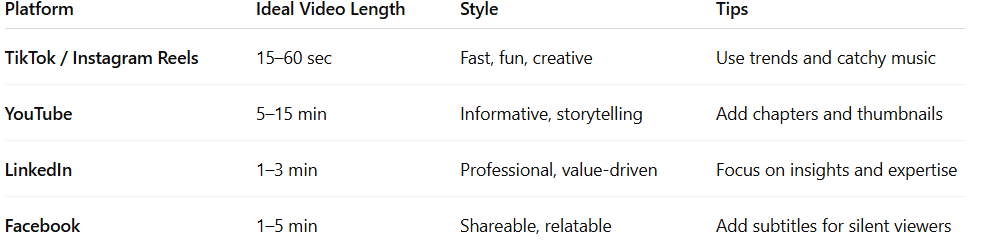
Example
A YouTube makeup tutorial is elaborate and 10 minutes long, but on Instagram Reels, it needs to be less than 30 seconds with quick cuts and music.
Example
A YouTube makeup tutorial is elaborate and 10 minutes long, but on Instagram Reels, it needs to be less than 30 seconds with quick cuts and music.
5. Add a Clear Call-to-Action (CTA)

No matter how fun your video is, it is not complete without a function. You must direct your audience on what action to take next — that’s where a **Call-to-Action (CTA)** enters.
Why a CTA Is Important
A CTA makes viewers become active actors — subscribers, followers, or buyers. It’s what induces conversions and assists you in meeting your objectives.
Types of CTAs
Engagement CTA: “Like, comment, and share this video!”
Subscription CTA: “Subscribe to my channel for more tips!”
Sales CTA: “Click the link below to buy now!”
Awareness CTA: “Follow us on Instagram for updates!”
Tips for Effective CTAs
Put them at the end or midway (post-delivering value).
Make them concise and to the point.
Employ on-screen text or buttons to make them explicit.
Employ energetic tone — not aggressive.
Example
In case you’re reviewing a product, conclude with: *”If you found this useful, do not forget to click on the subscribe button and look at the link below for today’s offer!”*
Bonus Tip: Keep It Authentic
Today’s audiences appreciate authenticity, not perfection. You don’t need to buy a studio or fancy equipment. What’s important is **authenticity** — being genuine, relatable, and human.
How to Be Authentic
* Display behind-the-scenes moments.
* Avoid over-editing or applying fake filters.
* Share both success and failures.
* Talk naturally — not script-style.
When others trust you, they watch more of your content and are more likely to forward it.
Conclusion
Creating engaging video content isn’t about luck — it’s about understanding what keeps people watching, connecting emotionally, and delivering value. Start with a strong hook, tell a story, focus on quality, know your audience, and end with a clear call-to-action. Combine these tips with consistency, and you’ll see your engagement, reach, and followers grow steadily.
Reminder
the aim is not only to have views but to **build a connection** that makes viewers become loyal fans or customers. Anyone can create effective videos that inspire, entertain, and convert using creativity, patience, and strategy.
FAQ on video content
Q1. What makes a video engaging?
A good video grabs attention fast, shares a believable story, and maintains the viewer emotionally or visually engaged until the very end. It has powerful visuals, good sound, and a compelling message.
Q2. How long should an engaging video be?
The optimal length varies with platform and intent. For short-form platforms such as TikTok or Instagram Reels, it is less than 60 seconds. For YouTube or educational videos, 5–10 minutes is optimal. The point is to make every second count.
Q3. What are some typical mistakes to avoid when creating video?
* Lame or slow introduction
* Bad audio quality
* Too lengthy content
* Lack of defined message or CTA
* Disregard for audience preferences
Avoiding all these errors can significantly enhance engagement.
Q4. Do I need to invest in costly equipment to produce quality videos?
Absolutely not! Most popular creators use phones and basic ring lights. What is essential is your creativity, storytelling, and connection with your audience.
Q5. What can I do to boost engagement on my videos?
* Post regularly.
* Ask questions to get comments.
* Address viewers in the comments.
* Add captions and hashtags.
* Cross-promote on multiple platforms.
Q6. What editing apps should a beginner use?
Well-known and easy-to-use choices include **CapCut**, **InShot**, **Canva Video Editor**, **Adobe Premiere Rush**, and **iMovie**. They have templates, transitions, and audio to choose from for both short and long videos.
Q7. How critical is background music in a video?
Music sets the mood and enhances the storytelling. Choose music that matches your message — upbeat for fun videos, calm for tutorials, emotional for stories. But make sure to use copyright-free tracks.
Q8. How often should I post video content?
Consistency is key. Posting 2–3 times per week works well for most creators. Focus on maintaining quality rather than quantity. Analyze performance to find your best posting days.
Q9. What are the measures that indicate if a video is engaging?
Check **watch time**, **audience retention**, **likes**, **shares**, **comments**, and **conversion rates**. Good watch time and retention typically indicate your content is engaging.
Q10. Are short videos as effective as longer ones?
Yes! Short videos tend to be more successful because they are simple to view and share. The trick is to convey your message in a short space of time and with originality.
for mor information themarketsufers.com
digital patner ask shashank sir